



MSO5034HD | 350 MHz 4Ch 12-Bit Mixed Signal Oscilloscope
Overview
The MSO5034HD is a 350 MHz, 4-channel mixed signal oscilloscope built on UNI-T’s R12™ native 12-bit ADC architecture, with a 5 GSa/s real-time sample rate (interleave mode), 500 Mpts standard memory depth, and a calculated rise time of ≤1.00 ns. The 12-bit resolution holds at the full 350 MHz bandwidth with no ERES averaging step or sample-rate trade-off, and Ultra Phosphor 3.0 acquisition delivers up to 800,000 wfms/s standard — 1,500,000 wfms/s in Sequential Mode. Sixteen digital channels are available with the UT-M15 logic probe pod, on a 10.1-inch capacitive multi-touch display.
For embedded prototyping with high-resolution requirements, four-channel mixed-signal debug in dedicated R&D groups, and lab benches that need real 12-bit acquisition without stepping up to a 1 GHz instrument, the MSO5034HD is the family-entry door into the HD-scope tier above MSO3000HD — double the sample rate (5 GSa/s vs 2.5 GSa/s), the same 500 Mpts memory, and the same nine-instrument workhorse platform, on a 10.1-inch capacitive multi-touch display.
Key Features
- 350 MHz Bandwidth, 4 Channels — 4-channel analog capture with 5 GSa/s sample rate and 12-bit native vertical resolution, scaling to 16-bit with ERES.
- 500 Mpts Memory Depth — Deep memory for extended captures without sample-rate trade-off; navigation and search across the full memory window.
- 800,000 wfms/s Standard, 1.5 M in Sequential Mode — Ultra Phosphor 3.0 intensity-graded display with 256 grayscale levels for rare-event hunting.
- R12™ Native 12-Bit ADC — 4,096 vertical levels at full bandwidth, sixteen times the resolution of a conventional 8-bit oscilloscope.
- Six Protocols Standard, Nine Optional — RS-232/UART, I²C, SPI, CAN, LIN included; CAN-FD, CAN-XL, FlexRay, SENT, Audio, MIL-STD-1553B, ARINC 429, Manchester, 1-Wire, and I3C optional.
- Built-in 2.5 GHz Spectrum Analyzer — Enhanced FFT up to 4 Mpts, four traces and four detections, waterfall display.
- Optional 50 MHz Dual-Channel AWG — Built-in arbitrary waveform generator pairs with the optional Bode plot analyzer for closed-loop frequency-response measurement.
- Optional Power Analysis Suite — Switching loss, harmonic analysis, SOA, RDS(on), modulation, slew rate, ripple analysis, and more.
- 16 Digital Channels with UT-M15 — Add the UT-M15 logic probe pod for time-correlated mixed-signal debug.
- 56 Automated Measurements with Histogram and Trend — 27 measurements simultaneously displayed; 39-item single-channel parameter snapshot.
- 10.1-Inch Capacitive Touchscreen — 1280×800 HD multi-touch with gesture support; full-SCPI WebServer for browser-based remote control.
Detailed Features
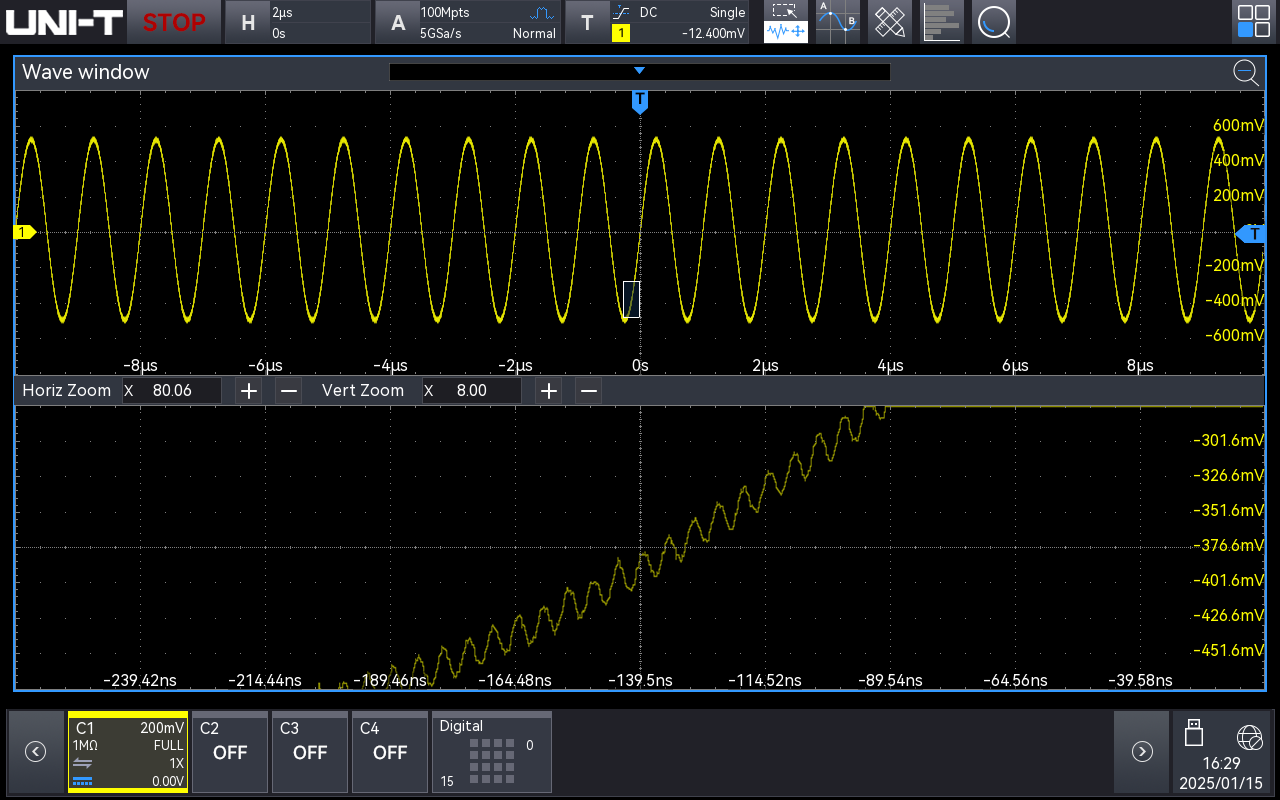
R12™ — Native 12-Bit at Full Bandwidth
R12™ is UNI-T’s native 12-bit ADC architecture: 4,096 vertical quantization levels — sixteen times the resolution of a conventional 8-bit oscilloscope — held at the full 350 MHz bandwidth and 5 GSa/s sample rate, with no ERES averaging step and no sample-rate trade-off to get there. ERES (enhanced resolution) extends effective vertical resolution up to 16-bit when bandwidth headroom is available, but the baseline 12-bit performance is the front-end’s native characteristic, not a software boost. For low-amplitude signal work — switching ripple riding on a busy DC rail, sensor-bridge outputs into a noisy ADC, jitter analysis on a clock line — the difference between 8-bit quantization steps showing through the measurement and 12-bit fidelity disappearing them is the difference between a usable capture and a noisy one.
R12™ native 12-bit ADC: 4,096 quantization levels, no ERES required.
Ultra Phosphor 3.0 — 800,000 wfms/s, 1.5 M in Sequential Mode
Ultra Phosphor 3.0 is UNI-T’s third-generation waveform-mapping architecture, combining parallel FPGA acquisition with 256-level grayscale intensity grading. Standard waveform capture rate is up to 800,000 wfms/s — high enough to surface intermittent timing anomalies on a long capture window without missing them between screen redraws. In Sequential Mode — the segmented-memory acquisition mode that conditions captures on a trigger event — capture rate climbs to 1,500,000 wfms/s, and the scope holds up to 400,000 frames of uninterrupted hardware real-time recording for post-capture replay and analysis. Rare-event hunting on a live system stops being a watch-and-wait exercise and starts being an analysis-after-capture exercise.
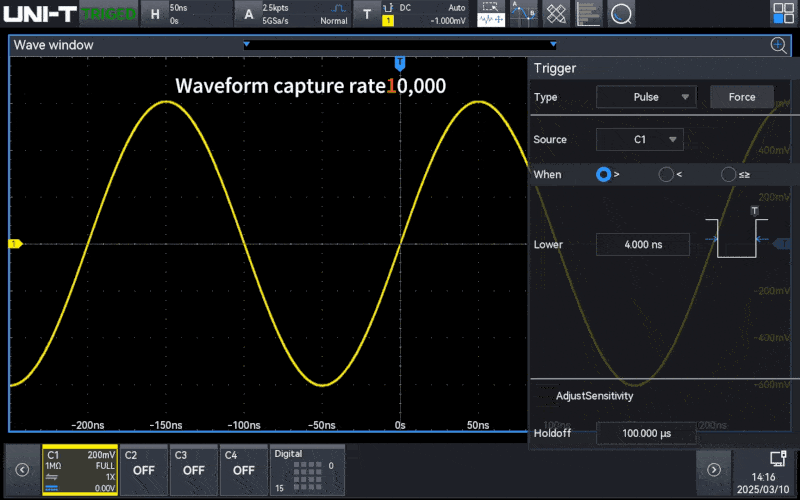 Ultra Phosphor 3.0: up to 800,000 wfms/s standard, 1,500,000 wfms/s in Sequential Mode.
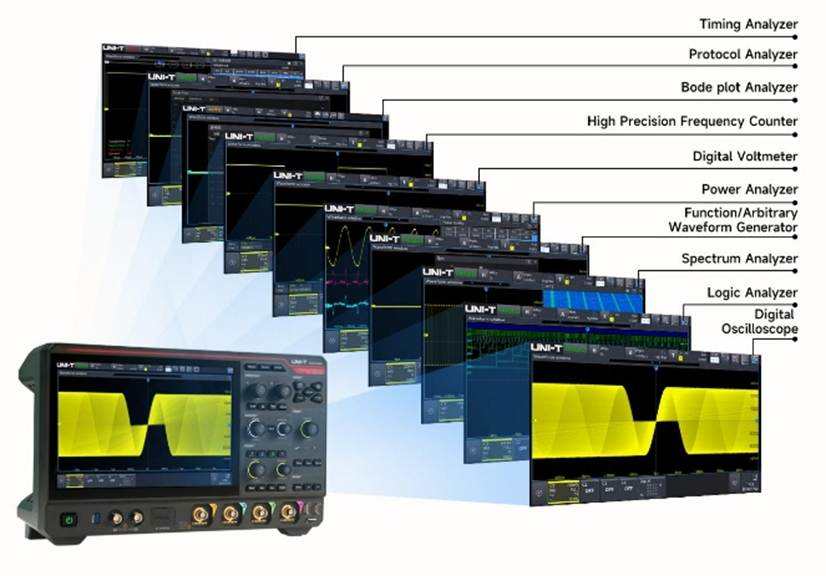
Nine Instruments in One — The HD Workhorse Platform
The MSO5000HD platform integrates nine instrument functions into one bench unit: digital storage oscilloscope, 16-channel logic analyzer (with the optional UT-M15 probe pod), 50 MHz dual-channel function and arbitrary waveform generator (optional), 2.5 GHz spectrum analyzer, 4-digit digital voltmeter, 7-digit hardware frequency counter, multi-protocol serial-bus analyzer, Bode plot analyzer (optional, paired with the AWG for closed-loop sweep), and power-electronics analyzer (optional). For small-lab consolidation and education-track lab benches, the integration replaces three to five separate instruments with one instrument footprint, one calibration chain, and one operator-training surface.
Nine instruments integrated: scope, logic analyzer, spectrum analyzer, AWG, DVM, frequency counter, protocol analyzer, Bode plot, power analyzer.
Deep Memory — 500 Mpts
500 Mpts of acquisition memory standard, with adjustable depths from Auto (5 Mpts) through 25 kpts, 250 kpts, 500 kpts, 5 Mpts, 50 Mpts, 100 Mpts, and 500 Mpts. Deep memory matters when the acquisition window is long — minutes-long captures looking for an intermittent fault, multi-frame protocol traces across a power-on sequence, or extended ripple analysis across a load-step transient — because the sample rate stays at 5 GSa/s for far longer than a shallow-memory scope before forcing a sample-rate trade-off. Combined with the navigation-and-search function (event, time, and marker navigation modes), the deep memory is searchable: zoom into a specific glitch in a 500 Mpt capture without scrolling through the rest.
16 Digital Channels with the UT-M15 Probe Pod (Optional)
Mixed-signal capability is hardware-standard in the MSO5000HD chassis — the 16-digital-channel logic-analyzer front end is built in. Adding the digital channels requires the optional UT-M15 logic probe pod, which provides separate high 8-bit and low 8-bit connections and connects directly to 8×2 square pins (2.54 mm) for fast attachment to development boards. Maximum digital sample rate is 1.25 GSa/s with a minimum detectable pulse width of 800 ps, and threshold selection covers TTL, 5.0 V/3.3 V/2.5 V/1.8 V CMOS, ECL, PECL, LVDS, and a custom level — covering essentially every common digital interface voltage on modern hardware. Digital and analog channels share the same time base, the same trigger system, and the same display, so a falling SPI clock edge and the analog-domain crosstalk it causes show up in the same frame.
15 Protocol Decoders — 6 Standard, 9 Optional
Six protocols decode standard with the MSO5000HD: RS-232/422/485/UART, I²C, SPI, CAN, and LIN. Nine additional protocols are available as separately licensed options: CAN-FD, CAN-XL, FlexRay, SENT, Audio (I²S/LJ/RJ/TDM), MIL-STD-1553B, ARINC 429, Manchester, 1-Wire, and I3C. The decoder runs on dedicated decode hardware, not a software post-processing path, so decode results display in real time during acquisition rather than after-the-fact on saved data — the difference between “debug a protocol stack interactively” and “capture, save, transfer, open in a separate tool, decode.” Trigger-and-decode operates pause-and-record modes for both interactive bring-up and unattended logging, and the event list plus search function lets you jump to a specific framed event across a 500 Mpt capture.
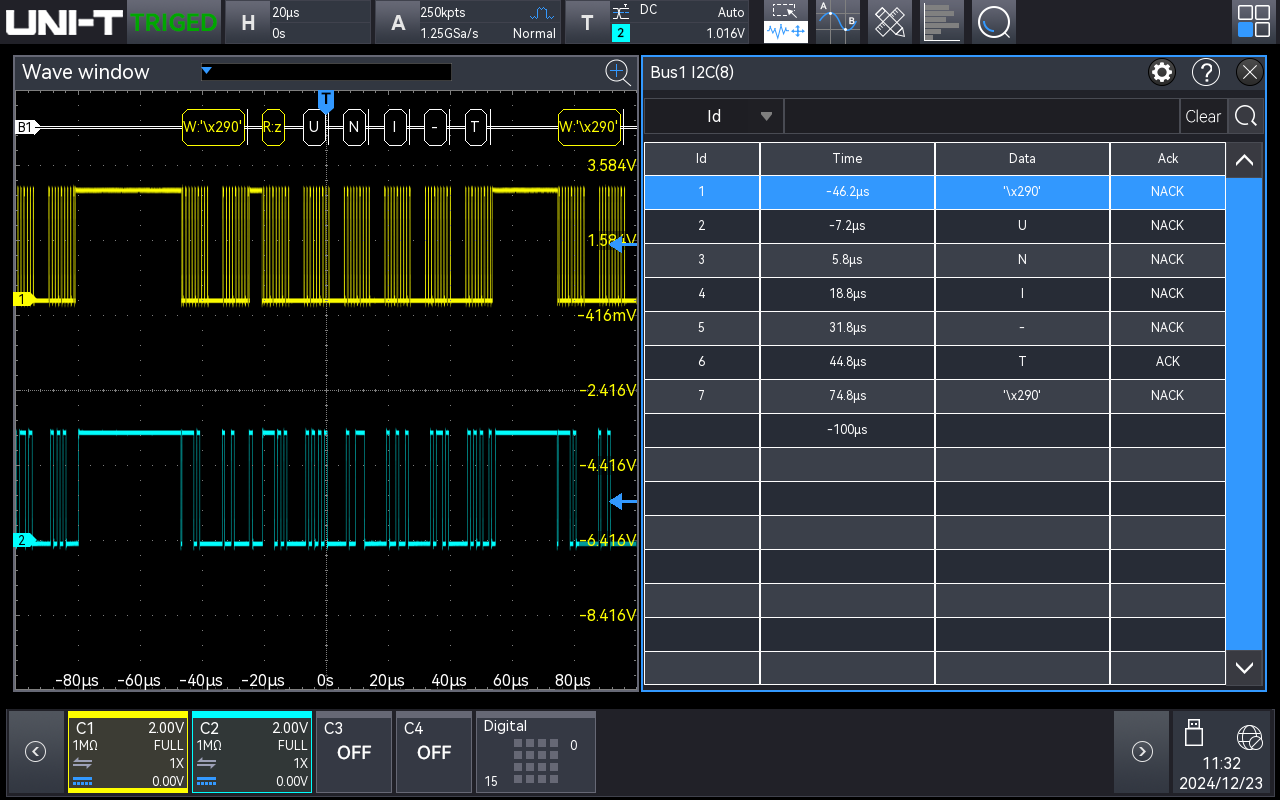 15 protocol decoders with hardware-accelerated decode and event search.
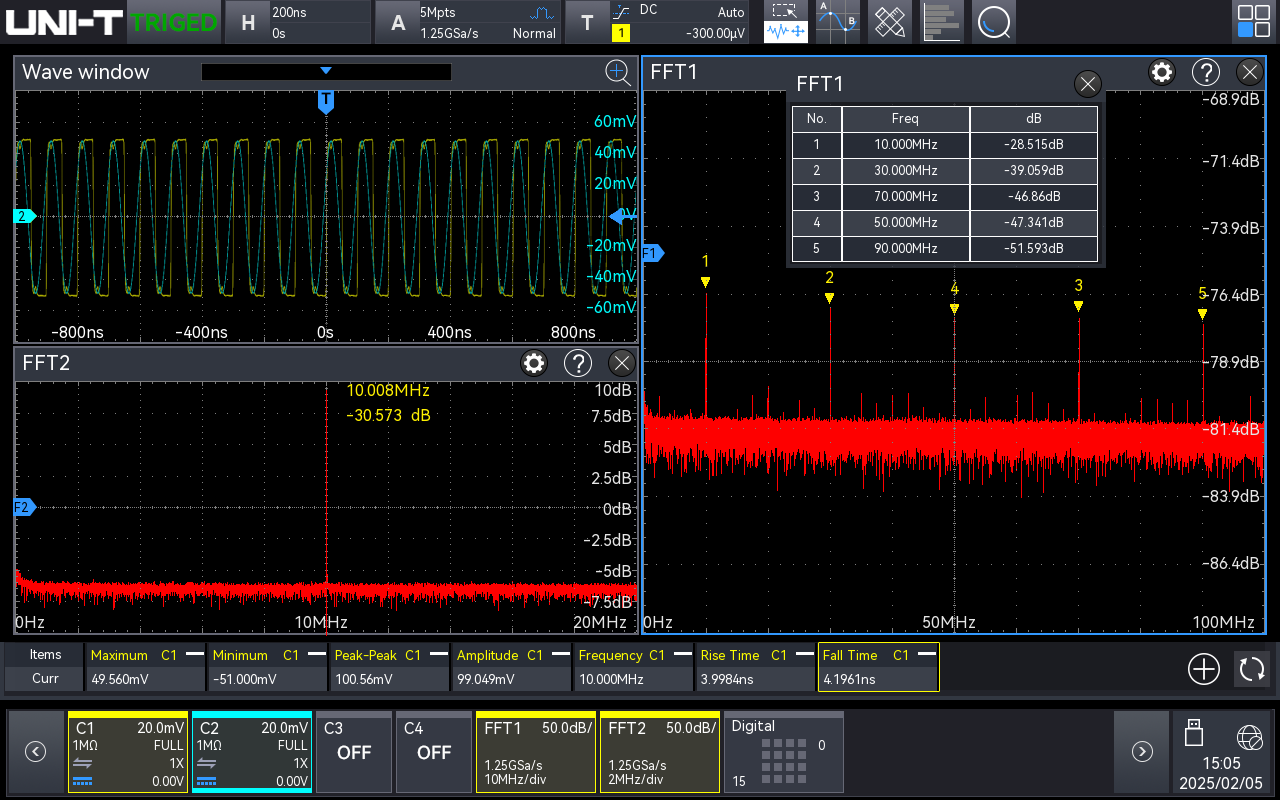
Built-In Spectrum Analyzer — 4 Mpts FFT to 2.5 GHz
The MSO5000HD’s built-in spectrum analyzer leverages the 5 GSa/s sample rate for a 0–2.5 GHz frequency range — useful for characterizing wideband signals, identifying spurious emissions, and verifying clock harmonics at frequencies beyond what 2.5 GSa/s instruments can analyze. Enhanced FFT supports up to 4 Mpts with 4-channel parallel signal analysis, four traces and four detections, auto/manual/threshold marker types, marker point lists, and a waterfall-curve display mode for time-evolving spectra. For pre-compliance EMI screening, switching-supply noise hunting, and clock-quality verification, the integrated spectrum analyzer means one instrument covers both time-domain and frequency-domain measurement needs.
Built-in spectrum analyzer: enhanced FFT up to 4 Mpts, 0–2.5 GHz frequency range.
Power Analysis — Optional Multi-Class Suite
The optional power-analysis package adds nine classes of power-electronics measurement to the MSO5000HD: power quality, surge current, safe operating area (SOA), harmonic analysis, RDS(on) measurement, modulation analysis, switching-loss analysis, slew rate, and ripple analysis — with transient-response and power-efficiency measurements added in firmware updates. For early-stage power-converter design, the package replaces a separate power-analyzer instrument: the same scope that captures the gate-drive waveform calculates the switching loss across the cycle, and the same FFT mode that screens for spurs computes the harmonic spectrum on the AC input. Connect a voltage probe and a current probe, select the analysis type, and the calculations run on-instrument — no post-processing workflow, no separate software tool.
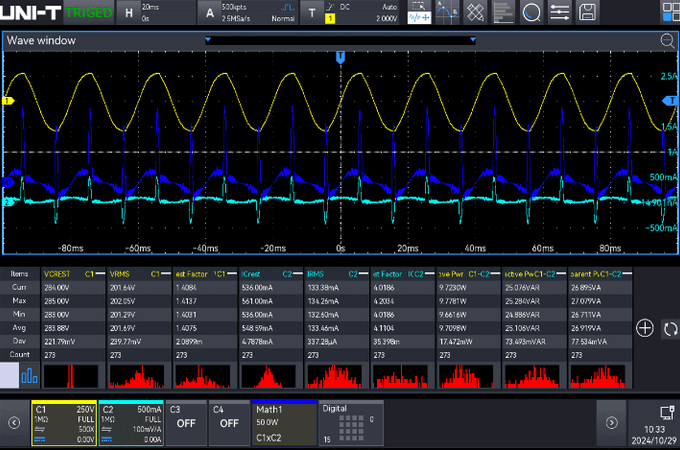 Optional power-analysis suite: switching loss, harmonic analysis, ripple, slew rate, modulation, safe operating area, transient response, power efficiency, turn on/off.
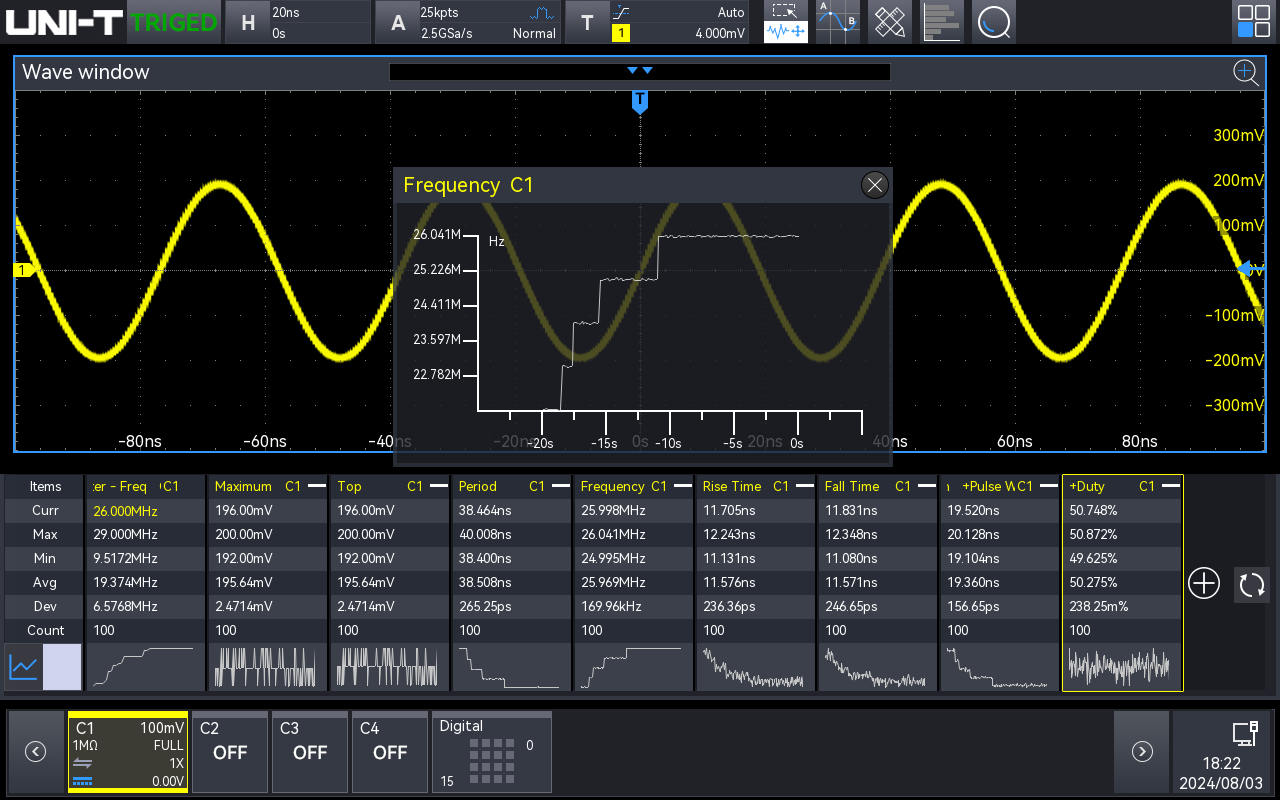
56 Automated Measurements with Histogram and Trend Statistics
56 automated measurement types cover voltage, time, frequency-domain, and area-under-curve calculations — with up to 27 measurements displayed simultaneously on screen and a 39-item single-channel parameter snapshot for production-style documentation. Histogram and trend-line displays show measurement statistics over time, useful for signal-integrity work where the parameter distribution matters as much as a single instantaneous value. The new top-and-bottom amplitude calculation strategy and the burst-region measurement function add capability for non-stationary signals where the measurement window has to be localized to a specific event rather than averaged across the full capture.
56 measurement types with histogram and trend-line statistics, up to 27 simultaneous on-screen.
Timing Analyzer — Bus Timing Conformance Testing
The timing analyzer function performs conformance-grade timing measurements on serial bus signals: pulse width, amplitude, edge characteristics, setup time, and hold time on I²C, SPI, CAN, and I²S buses. For consumer-electronics manufacturing — mobile phones, smart wearables, home appliances, multimedia audio-video equipment, and automotive electronics — bus-timing consistency is the difference between a board that passes audit and one that fails customer qualification. The MSO5000HD generates exportable conformance test reports, turning the scope into a documentation tool for design verification and test-lab compliance work.
10.1-Inch Touch UI, WebServer, and SCPI Automation
A 10.1-inch 1280×800 capacitive multi-touch display anchors the front-panel experience — touch, drag, pinch-to-zoom, and rectangle-drawing gestures for common waveform operations — while preserving the traditional knob-and-key controls that bench engineers want for fine adjustment. Mouse and keyboard are supported as additional input methods. For automation, the built-in WebServer provides browser-based instrument control over the network — SCPI commands, waveform export, and online user-manual access — from PC or mobile devices, and full SCPI compliance over LAN or USB Device enables programmatic control from LabVIEW, Python, or any SCPI-aware test framework. UNI-T’s free instrument manager runs on the PC side for graphical control without writing custom automation code.
Applications
R&D and Embedded Validation
For R&D validation on multi-rail digital boards, the MSO5034HD’s 12-bit native resolution at 350 MHz keeps low-amplitude signal artifacts — switching ripple, crosstalk, return-path noise — visible at scale during overnight regression captures, with 500 Mpts memory enabling deep zoom-and-search across long capture windows.
Power Electronics Design and Validation
For power-electronics design at moderate switching frequencies, the MSO5034HD pairs four-channel acquisition with optional power-analysis software for switching-loss, efficiency, and ripple measurement on switch-mode and battery-management designs — same instrument, no separate power analyzer required.
Test Laboratory and Consultancy Work
For internal test labs documenting compliance and pre-compliance characterization, the MSO5034HD’s 56 automated measurements with histogram and trend statistics, paired with hardware-accelerated template testing, generate the kind of pass/fail evidence reports that internal-audit and external-customer test packages require.
Accessories
Included in Box
- Power cord (region-specific)
- USB cable
- Quick start guide
- Calibration certificate
- Probe set: passive 10:1 voltage probes (4×) sized for the bandwidth of the analog front end
Recommended Add-Ons
- UT-M15 Logic Probe Pod — adds 16 digital channels with high/low 8-bit connectors and direct 8×2 square-pin attachment.
- Active probes — for 50 Ω high-bandwidth signal-integrity work where a passive 10x probe limits visibility.
- Current probe(s) — for power-electronics work paired with the optional power-analysis suite; voltage and current probe simultaneously for switching-loss measurement.
- AWG license — activates the dual-channel 50 MHz arbitrary waveform generator hardware in the chassis.
- Bode plot license — pairs with the AWG for closed-loop frequency-response sweep on amplifiers, filters, and power-supply control loops.
- Power analysis license — activates the multi-class power-electronics measurement suite.
- Protocol decoder licenses — CAN-FD, CAN-XL, FlexRay, SENT, Audio, MIL-STD-1553B, ARINC 429, Manchester, 1-Wire, I3C, available individually.
Frequently Asked Questions
What protocols are included with the MSO5000HD as standard?
RS-232/422/485, UART, I²C, SPI, CAN, and LIN are decoded standard with no additional license required. CAN-FD, CAN-XL, FlexRay, SENT, Audio (I²S/LJ/RJ/TDM), MIL-STD-1553B, ARINC 429, Manchester, 1-Wire, and I3C are available as separately licensed options — activated on the same instrument with no firmware upgrade or reflash required.
What is the practical advantage of 12-bit native resolution over 8-bit?
A 12-bit ADC provides 4,096 vertical quantization levels compared to 256 for an 8-bit scope — sixteen times the resolution. In low-amplitude work (switching ripple riding on a DC rail, sensor outputs from a strain gauge, jitter on a clock line, or any signal where the amplitude of interest is much smaller than the channel’s full-scale range), 8-bit quantization steps show up as visible stair-stepping in the captured waveform. 12-bit acquisition keeps those steps below the front-end’s noise floor, so what you’re looking at on screen is the signal, not the digitization grid.
How do I add 16 digital channels for mixed-signal work?
The 16-digital-channel logic-analyzer front end is built into every MSO5000HD chassis as hardware-standard. To use it, add the optional UT-M15 logic probe pod, which provides separate high 8-bit and low 8-bit pin connections and attaches directly to standard 2.54 mm 8×2 square-pin headers on development boards. Maximum digital sample rate is 1.25 GSa/s with an 800 ps minimum detectable pulse width.
What is the difference between Ultra Phosphor 3.0’s 800,000 wfms/s standard rate and the 1,500,000 wfms/s sequential-mode rate?
The 800,000 wfms/s rate is the continuous waveform-capture rate during normal acquisition — the rate at which the scope acquires, processes, and displays new waveforms back-to-back during live operation. The 1,500,000 wfms/s sequential-mode rate applies in segmented-memory acquisition where the scope captures only a short window around each trigger event, then re-arms quickly for the next trigger; this maximizes capture density when chasing intermittent events at the cost of dead time between captures. In practical terms: continuous 800K for general-purpose acquisition, sequential 1.5M for rare-event hunting on a triggered signal.
Is the AWG (arbitrary waveform generator) included or optional?
The AWG hardware is built into every MSO5000HD chassis as hardware-standard, but activation requires the AWG software license. Once activated, it provides dual-channel 50 MHz output with sine, square, pulse, ramp, arbitrary, noise, and DC waveforms; AM, FM, ASK, FSK, and sweep modulation; and the ability to load on-screen captured waveforms back to the Gen output for replay-style stimulus testing. The optional Bode plot analyzer pairs with the AWG for closed-loop frequency-response measurement.
Can I control the MSO5000HD remotely without installing local software?
Yes. The built-in WebServer provides full instrument control through any standard web browser on a PC, tablet, or mobile device on the same network — no client install, no driver download. Common operations (waveform capture, screenshot, parameter readback, settings changes, file export) work directly through the browser. For programmatic control, the same interface accepts SCPI commands over LAN or USB, compatible with LabVIEW, Python, MATLAB, and any SCPI-aware automation framework. UNI-T also provides a free instrument-manager application for users who prefer a graphical desktop client.
Part of the MSO5000HD oscilloscope series. See the series page to compare bandwidth and channel options across the lineup, or explore the broader UNI-T oscilloscope catalog.
Warranty
This instrument is backed by UNI-T's 3+2 Year Warranty — 3 years of standard coverage, plus 2 additional years free when you register your product. That's 5 years of total protection at no extra cost.
The warranty covers manufacturing defects and component failures under normal use conditions. UNI-T instruments are built for professional daily use, and our warranty reflects that commitment to long-term reliability.
| Analog Bandwidth (50 Ω, −3 dB) | 350 MHz |
| Analog Bandwidth (1 MΩ, −3 dB) | 350 MHz |
| Channels | 4 Analog + 16 Digital (with optional UT-M15 probe pod) |
| Real-Time Sample Rate | 5 GSa/s (interleave mode) / 2.5 GSa/s (non-interleave mode) |
| Digital Channel Sample Rate | 1.25 GSa/s |
| Vertical Resolution | 12-bit native (up to 16-bit with ERES) |
| Memory Depth | 500 Mpts maximum per channel |
| Capture Rate | 800,000 wfms/s standard; 1,500,000 wfms/s in Sequential Mode |
| Calculated Rise Time (10–90%, Typ.) | ≤1.00 ns |
| Background Noise (full BW, Typ.) | 75 µVrms |
| Display Size | 10.1 inches |
| Display Resolution | 1280 × 800 |
| Touch Screen | Capacitive multi-touch |
| Sequential Sampling | Maximum 400,000 frames; minimum two trigger intervals < 700 ns |
| Hardware Real-Time Waveform Recording | 400,000 frames |
| Trigger Modes | 12 types: edge, pulse width, video, ramp, runt, over-amplitude, delay, timeout, duration, setup & hold, Nth edge, code pattern; Zone trigger |
| Protocol Triggering and Decoding | 15 protocols total. Standard: RS-232/422/485/UART, I²C, SPI, CAN, LIN. Optional: CAN-FD, CAN-XL, FlexRay, SENT, Audio, MIL-STD-1553B, ARINC 429, Manchester, 1-Wire, I3C |
| Spectrum Analyzer | 0–2.5 GHz, enhanced FFT up to 4 Mpts, 4-channel parallel |
| Built-in AWG (Optional) | 50 MHz equivalent, dual-channel, 312.5 MSa/s, 16-bit |
| Bode Plot Analyzer | Optional — frequency response, loop stability, filter, amplifier |
| Power Analyzer | Optional — switching loss, harmonics, ripple, slew rate, RDS(on), SOA, modulation, transient response, power efficiency |
| Automated Measurements | 56 types; up to 27 simultaneous; histogram and trend display |
| Maximum Input Voltage (1 MΩ) | 400 V (DC + ACVpk); 135 VRMS |
| Maximum Input Voltage (50 Ω) | 5 VRMS max |
| Connectivity | USB Host/Device, LAN, EXT Trig, AUX Out (Trig Out / Pass-Fail / DVM), Gen Out, HDMI |
| Remote Control | SCPI over LAN/USB; built-in WebServer (browser, PC + mobile); UNI-T Instrument Manager |
| Compliance | RoHS |
Data Sheets and Manuals
Software / Firmware Downloads
Authentic UNI-T accessories are an affordable way to extend the functionality of your instrument.
MSO5000HD Options 18
Need to add specific functionality to your UNI-T instrument? Here are our options for specific applications and measurement types. Have a question? Contact us at 888-668-UniT (8648).

MSO5000HD-1WIRE 1-Wire Serial Bus Trigger and Analysis Option
$279.00
MSO5000HD-ARINC429 Aerospace ARINC429 Serial Bus Trigger and Analysis
$279.00
MSO5000HD-AUDIO Audio Serial Bus Trigger and Analysis
$279.00
MSO5000HD-AUTO Automotive Serial Bus Trigger and Analysis Option
$829.00
MSO5000HD-AWG 50 MHz 2Ch Arbitrary Waveform Generator with Bode Plot
$279.00
MSO5000HD-BND Complete Serial Analysis Bundle
$1,369.00
MSO5000HD-BW3M5T1G 1GHz bandwidth upgrade
$3,199.00
MSO5000HD-BW3M5T5M 500MHz bandwidth upgrade
$1,199.00
MSO5000HD-BW5MT1G 1GHz bandwidth upgrade
$1,999.00
MSO5000HD-CANFD Automotive CAN-FD Serial Bus Trigger and Analysis
$279.00
MSO5000HD-CANXL Automotive CAN-XL Serial Bus Trigger and Analysis
$279.00
MSO5000HD-FLEX Automotive FlexRay Serial Bus Trigger and Analysis
$279.00
MSO5000HD-I3C Embedded Systems I3C Serial Bus Trigger and Analysis
$279.00
MSO5000HD-MANCH Manchester Serial Bus Trigger and Analysis Option
$279.00
MSO5000HD-MIL1553 MIL-STD-1553 Serial Bus Trigger and Analysis Option
$279.00
MSO5000HD-PWR Advanced Power Analysis
$829.00
MSO5000HD-SENT Automotive SENT Serial Bus Trigger and Analysis
$279.00
MSO5000HD-TIMING Advanced Timing Analysis
$549.00Passive Probes 10

UT-P01 25 MHz 10:1 General Purpose Oscilloscope Probe
$15.00
UT-P03 60 MHz 10:1 General Purpose Oscilloscope Probe
$18.00
UT-P04 100 MHz 10:1 General Purpose Oscilloscope Probe
$15.99
UT-P05 200 MHz 10:1 General Purpose Oscilloscope Probe
$20.00
UT-P06 300 MHz 10:1 General Purpose Oscilloscope Probe
$36.00
UT-P07A 500 MHz 10:1 General Purpose Oscilloscope Probe
$49.00
UT-P08A 350 MHz 10:1 General Purpose Oscilloscope Probe
$49.00
UT-P20 250 MHz 100:1 High Voltage Oscilloscope Probe
$54.00
UT-P21 50 MHz 1000:1 High Voltage Oscilloscope Probe
$410.00
UT-V23 High Voltage Scope Probe
$24.00Current Probes 6

UT-P40 DC-100 kHz 60A AC/DC Current Probe
$430.00
UT-P41 DC-100 kHz 100A AC/DC Current Probe
$567.00
UT-P4150 12 MHz High-Frequency DC/AC Current Probe
$2,529.00
UT-P42 150 kHz 200A AC/DC Current Probe
$437.00
UT-P43 DC-25 MHz 20A 100mV/A Current Probe
$910.00
UT-P44 DC-50 MHz 40A 50mV/A Current Probe
$1,615.00Differential Probes 6

UT-P30 100 MHz 10:1/100:1 Differential Oscilloscope Probe
$379.00
UT-P31 100 MHz 10:1/100:1 Differential Oscilloscope Probe
$666.00
UT-P32 50 MHz 100:1/1000:1 Differential Oscilloscope Probe
$820.00
UT-P33 120 MHz 10:1/100:1 Differential Oscilloscope Probe
$1,396.00
UT-P35 50 MHz 50:1/500:1 Differential Oscilloscope Probe
$376.00


