
Generators
Signal generators produce calibrated, controllable test signals — sine, square, arbitrary waveforms, RF carriers, and modulated formats — for stimulating circuits under test, simulating sensors, verifying receivers, and characterizing analog and digital systems. The generator catalog spans arbitrary waveform generators from 20 MHz to 600 MHz across Classic, Essential, Advanced, Performance, and Elite series, plus RF signal generators covering 9 kHz to 40 GHz in both analog and vector-modulation configurations for receiver test, EMC pre-compliance, and protocol validation.


Waveform Signal Generators
DDS waveform generators from 25MHz to 600MHz

RF Signal Generators
Analog and vector RF signal generators up to 22GHz
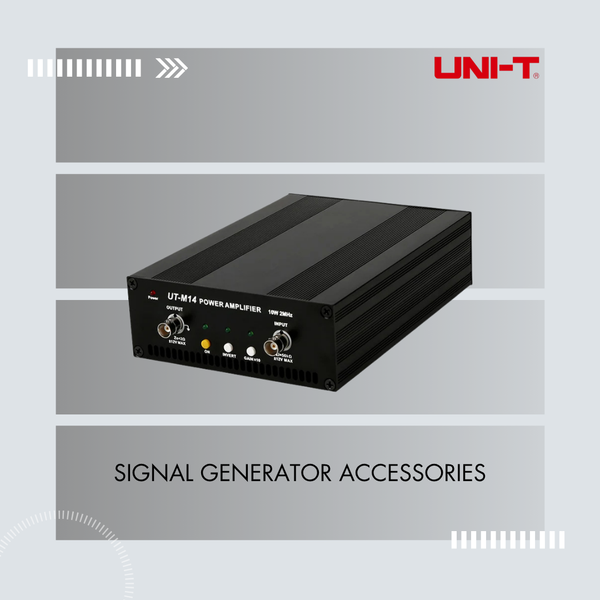
Signal Generator Accessories
Amplifiers and accessories for UNI-T waveform generators
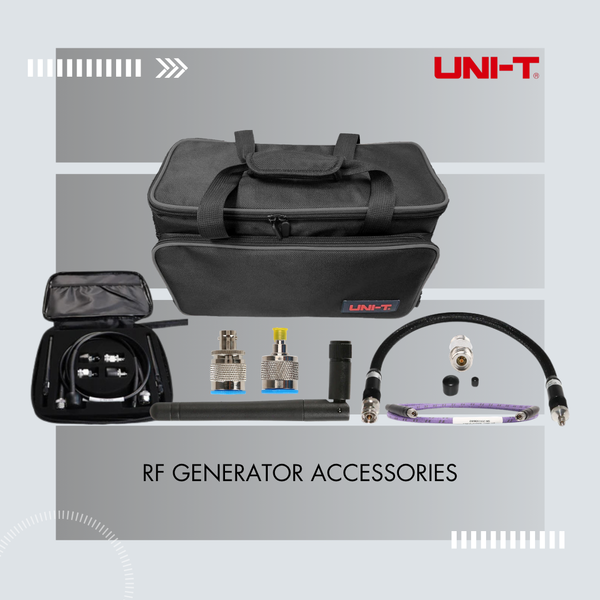
RF Generator Accessories and Options
Cables, attenuators, and accessories for RF generators
UNI-T Signal Generators — Buyer's Guide
About This Collection
UNI-T's signal generator catalog covers two distinct measurement worlds: 23 waveform/function generators for baseband and modulated signals up to 600 MHz, and 14 RF signal generators for radio-frequency stimulus from 9 kHz to 22 GHz. This guide helps you pick the right family before you drill into specific models.
If you already know which side you need, jump straight to Waveform Signal Generators or RF Signal Generators. If you're not sure, read on.
Two Generator Families, Two Use Cases
Waveform / Function / Arbitrary Generators
RF Signal Generators
Decision: Which Family Do You Need?
The dividing line is roughly the upper frequency of the signal you're producing and whether you need calibrated RF output power. Use these rules of thumb:
| If your work involves... | You want |
|---|---|
| Signals below ~100 MHz, analog or digital baseband | Waveform Generator |
| Sensor simulation, DAC/ADC test, audio, ultrasonic | Waveform Generator |
| Custom or arbitrary waveform playback | Waveform Generator |
| Pulse, burst, FSK, ASK, PSK at logic-level rates | Waveform Generator |
| RF CW stimulus above ~100 MHz with calibrated power | RF Generator |
| Tight phase-noise spec (e.g. −110 dBc/Hz or better) | RF Generator |
| Vector / I-Q modulation for digital comms standards | RF Generator |
| EMC pre-compliance, antenna, radar, wireless test | RF Generator |
Overlap zone (10–600 MHz): UNI-T's Elite-Series UTG9000T/T+ waveform generators reach 600 MHz with 16-bit vertical resolution — legitimate competition for entry-tier RF work where the modulation format is straightforward. If you need vector modulation or output power calibration, you still want an RF generator. If you need a sharp pulse with custom shape and a wide modulation envelope, the high-end waveform generator wins.
Waveform Generator Tiers at a Glance
UNI-T waveform generators ladder by bandwidth, sample rate, and feature depth across five series.
| Series | Bandwidth | Channels | Best for |
|---|---|---|---|
| UTG900E Classic | 30 – 60 MHz | 2 | Education, hobby, basic lab stimulus |
| UTG1000X Essential | 20 – 40 MHz | 2 | Embedded debug, with optional 4 W power amplifier variant |
| UTG2000A/B Advanced · UTG2000X | 60 – 120 MHz | 2 | Mid-tier lab, broader modulation, deeper memory |
| UTG4000A · UTG4000X Performance | 80 – 250 MHz | 2 – 4 | Production test, automated benches, 4-channel work |
| UTG9000T · UTG9000T+ Elite | 350 – 600 MHz | 4 | 16-bit flagship, high-fidelity arb playback, PRBS & digital-bus output |
For a deeper walk-through of every waveform tier, model deltas, and 4-channel vs 2-channel selection, see the Waveform Signal Generator Buyer's Guide.
RF Generator Tiers at a Glance
UNI-T RF generators come in two frequency platforms (USG3000 mid-band, USG5000 high-band), each in Analog (M) and Vector (V) configurations, with optional mechanical attenuator (-P) for high-cycle automated test.
| Platform | Frequency | Modulation | Best for |
|---|---|---|---|
| USG3000M Analog | 9 kHz – 4.5 / 6.5 GHz | AM, FM, PM, pulse | Receiver test, basic comms, IF stages, EMC pre-compliance |
| USG3000V Vector | 9 kHz – 4.5 / 6.5 GHz | + I/Q digital (QAM, PSK, FSK, MSK) | Wireless protocol test, digital comms, modulation-analysis benches |
| USG5000M Analog | 9 kHz – 14 / 22 GHz | AM, FM, PM, pulse | Radar, microwave subsystem test, satellite-band stimulus |
| USG5000V Vector | 9 kHz – 14 / 22 GHz | + I/Q digital | Wide-band wireless, microwave digital comms, high-frequency vector test |
For the full RF generator breakdown including phase-noise specs, attenuator options, and analog-vs-vector tradeoffs, see the RF Signal Generator Buyer's Guide.
What All UNI-T Generators Share
FAQ
I need a sine wave at 100 MHz. Waveform or RF generator?
Either works for the frequency. The deciding question is what you do with it: if it's stimulus into a logic input, an audio analyzer, or a baseband measurement chain, a 120-MHz-class waveform generator (UTG2000B/X or UTG4000A) is the cleaner choice and gives you arbitrary-waveform playback in the same chassis. If it's stimulus into an RF input that needs calibrated power level or tight phase noise, you want an RF generator like the USG3000M.
Do I need a Vector RF generator if I'm not doing 5G or LTE?
Probably not. The Analog M-series covers AM, FM, PM, and pulse modulation — enough for most receiver test, EMC pre-compliance, and traditional analog comms work. The Vector V-series adds I/Q digital modulation for QAM, PSK, FSK, MSK and standards-based wireless work. If your test envelope is purely analog modulation today and you don't see digital comms work on the horizon, save the cost and buy Analog.
What's the difference between a waveform generator with FSK/PSK modes and a vector RF generator?
The waveform generator outputs digital modulation at baseband or with a low-frequency carrier — useful for serial-protocol stimulus, sensor simulation, and embedded debug. The vector RF generator places real digital modulation on a calibrated RF carrier with specified power level, phase noise, and EVM. For protocol debug at logic level, waveform generator wins on cost and flexibility. For wireless receiver test, only the vector RF generator gives you the calibrated RF signal you need.
Can I use a UTG9000T+ (600 MHz waveform) instead of a USG3000M (RF, up to 6.5 GHz)?
Only if your work stays below 600 MHz and you don't need calibrated RF output power or RF-grade phase noise. The UTG9000T+ produces an excellent signal up to 600 MHz with 16-bit vertical resolution and deep arb memory, but its output amplitude is rated at the output connector into 50 Ω rather than calibrated as an RF source. For receiver test, antenna characterization, or any work that requires a known RF power into a load, use an RF generator.
What about output power? How much can these generators drive?
Waveform generators: typically up to 10 Vpp into 50 Ω (5 Vpp at the load), with the UTG1022X-PA option providing 4 W of amplification when you need to drive a low-impedance load. RF generators: typically −127 to +20 dBm output range with electronic step attenuator; -P variants add a mechanical attenuator for high-cycle automated test reliability. Check the specific model page for exact figures.
What's included with every generator?
Every UNI-T generator ships with a power cord, USB cable, calibration certificate, and PC software for SCPI control and arbitrary-waveform editing. Probes, cables, and N-to-BNC adapters are sold separately under the Signal Generator Accessories collection.

