
Oscilloscopes
Oscilloscopes visualize voltage signals over time — the foundational tool for electronics design, embedded development, signal integrity analysis, and educational labs. The UNI-T oscilloscope catalog spans entry-tier 50 MHz two-channel scopes through 8 GHz lab-grade four-channel instruments, including 8-bit digital storage oscilloscopes for general-purpose work and 12-bit high-definition scopes for power-integrity and precision analog applications. Mixed-signal models add integrated logic-analyzer channels for embedded debug; rack-mount form factors serve ATE racks and headless test stations; eight-channel configurations serve multi-rail power characterization. Across the catalog, capability scales through lifetime-unlock option licenses for bus decode, advanced power analysis, jitter and eye-diagram analysis, AWG, and bandwidth upgrades.

UNI-T Oscilloscope — Buyer's Guide
Start Here: 8-bit or 12-bit?
Every digital scope reduces a continuous voltage to a finite number of discrete steps. An 8-bit scope resolves 256 steps across its vertical range. A 12-bit scope resolves 4,096 steps — 16× finer. That single decision determines whether you can see what you need to see on small signals riding on top of large ones, or whether they disappear into the noise floor.
Pick 8-bit (DSO or MSO) for general electronics work, signal integrity, and protocol debug. Pick 12-bit (HD) for power electronics, low-level analog, and any measurement where you need to read a small variation in the middle of a large signal.
What Resolution Actually Buys You
12-bit = 4,096 levels (16× finer)
Decision 1: Pick Your Bit Depth
8-bit Digital Oscilloscopes (DSO & MSO)
12-bit HD Oscilloscopes
Decision 2: When Does Bit Depth Matter More Than Bandwidth?
Bandwidth tells you what frequencies you can faithfully reproduce. Bit depth tells you how finely you can measure amplitude. Most buyers default to bandwidth first, but the cases below are where 12-bit changes the answer to your measurement.
| Measurement | What you need | Why |
|---|---|---|
| Switching converter ripple on a DC rail | 12-bit | 30 mV ripple on a 48 V rail is 0.06% of full-scale — lost in 8-bit noise |
| Audio THD & harmonics | 12-bit | Harmonic distortion measurements below −60 dBc need the dynamic range |
| Motor inverter PWM with current sense | 12-bit | You want both the 400 V bus and the 100 mV current-shunt visible at the same scale |
| Logic-level signal integrity | 8-bit | 3.3 V edges in a 5 V window — bandwidth and trigger flexibility win, bit depth doesn't help |
| Serial bus protocol decode (I²C, SPI, UART, CAN) | 8-bit | You're reading ones and zeros; the decoder doesn't care about amplitude resolution |
| Production test against spec limits | 8-bit | Go/no-go is a tolerance band, not a precision amplitude measurement |
| RF and high-speed digital | 8-bit at higher bandwidth | 2 GHz at 8-bit gives you frequency reach 12-bit at 1 GHz can't match |
The pattern: bit depth wins for amplitude precision (power, audio, precision analog). Bandwidth wins for time precision (digital edges, RF, protocol). Both are equally important — pick by what your work measures.
Decision 3: How Much Bandwidth?
| Your fastest signal of interest | Pick at least | Why |
|---|---|---|
| Audio, sensors, low-speed analog | 50 – 100 MHz | 5× rule on signals under 20 MHz; covers harmonics |
| Embedded micros, basic logic, serial buses | 100 – 200 MHz | Capture edges on 50–100 MHz clocks cleanly |
| Power-supply switching, motor drives | 100 – 350 MHz (12-bit) | Switching nodes ring above 100 MHz; bit depth matters more than raw GHz |
| FPGA / DDR / fast logic | 500 MHz – 1 GHz | Edge rates faster than 500 ps require sub-ns rise time |
| RF, microwave, high-speed digital | 1 GHz – 2 GHz | 2 GHz HD covers 5G FR1, USB 3.2 Gen 1, PCIe Gen 1/2 signal-integrity work |
| Research, lab-grade, multi-Gbps serial | 2 GHz – 8 GHz | Flagship MSO8804HD (8 GHz, 12-bit) and MSO7204X (2 GHz, 8-bit, 9-in-1) |
The Three Collections
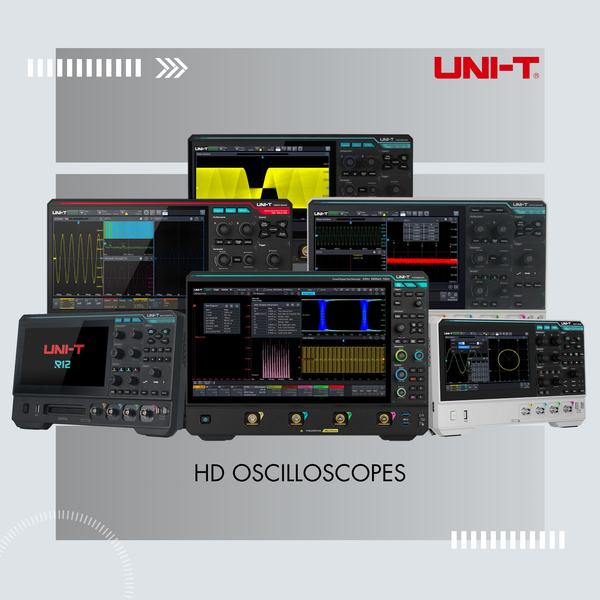
HD Oscilloscopes (12-bit)
Browse HD scopes → 21 models, 70 MHz to 8 GHz, every model 12-bit native. The right choice for power, precision, motor drives, EV, audio, and anywhere amplitude resolution matters more than top-end bandwidth.
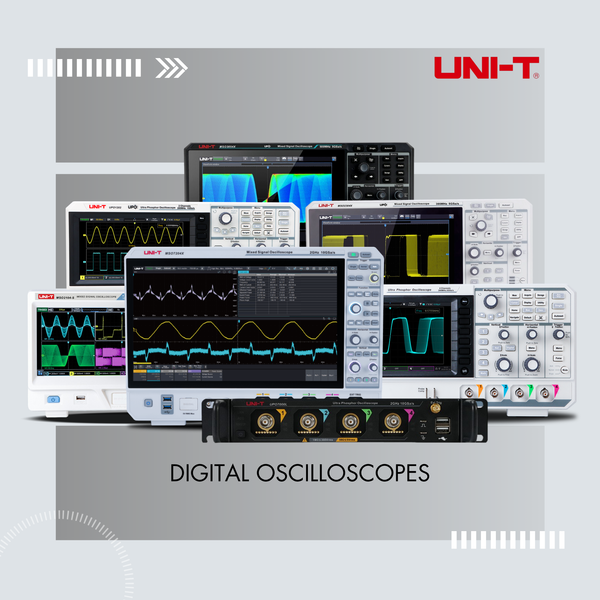
Digital Oscilloscopes (8-bit DSO & MSO)
Browse 8-bit scopes → 51 models from $209 entry-level through 2 GHz lab-grade. DSO for analog work, MSO for mixed-signal with 16 digital channels. The right choice for general electronics, embedded, protocol debug, education, and production.
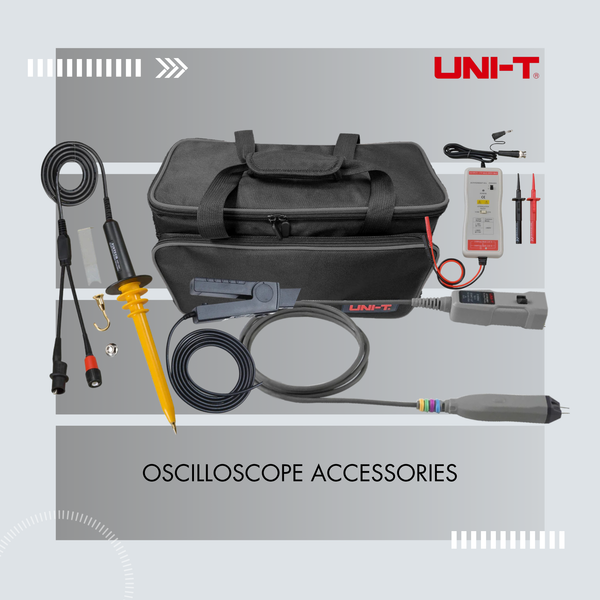
Oscilloscope Accessories
Browse accessories → Passive probes, high-voltage differential probes, AC and DC current probes, active probes, rack ears, and replacement parts for every chassis in the catalog.
Why Choose UNI-T?
One feature set, two bit depths
Both 8-bit and 12-bit lines share the same nine-in-one architecture: scope, logic analyzer, function generator, jitter analyzer, power analyzer, spectrum analyzer, protocol analyzer, counter, and DMM — capabilities that replace separate instruments on the bench.
Deep memory standard
500 kpts to 2 Gpts of capture depth depending on platform, with up to 2 million waveforms per second update rate on the X-series. You see infrequent events without hunting for them.
Protocol decode included
I²C, SPI, UART, CAN, LIN, RS-232, RS-485 decode is standard across the line. No license keys, no per-protocol upcharge.
5-year warranty
Five years parts, labor, return shipping — longer than typical 2- and 3-year industry warranties at every price point.
FAQ
I'm not sure if I need 8-bit or 12-bit. What's the safe default?
If your work is primarily power electronics, motor drives, switching converters, EV, battery, audio, or precision analog — pick 12-bit HD. If your work is embedded, digital, FPGA, RF, communications, protocol debug, or education — pick 8-bit DSO or MSO. Mixed bench? An 8-bit MSO covers more general cases; HD is the upgrade when you keep wishing you could see smaller signals.
Can I get 12-bit from an 8-bit scope using high-resolution mode?
High-resolution (Hi-Res) mode on 8-bit scopes averages adjacent samples to suppress noise — effective bits typically reach 11–12 ENOB but at the cost of bandwidth and at the cost of temporal resolution. Native 12-bit acquisition gives you the dynamic range at full bandwidth, all the time, without trading sample rate. For occasional precision work, Hi-Res mode is fine. For routine precision work, native 12-bit is the right tool.
Why is bit depth tied to bandwidth in the spec sheet?
It isn't, conceptually — they're independent axes. The reason UNI-T's catalog correlates them is that the buyer profiles do too: an engineer who needs 12-bit usually also needs deep memory and analog channel count more than top-end GHz, while RF and high-speed digital buyers need bandwidth more than amplitude resolution. The HD line tops out at 8 GHz to cover the rare overlap (8 GHz, 12-bit lab-grade) for buyers who need both.
What about MSO vs DSO inside 8-bit?
MSO adds 16 digital channels for capturing logic alongside analog — the right tool for embedded debug, FPGA work, and protocol analysis. DSO has analog channels only; lower cost, smaller chassis, simpler workflow when you don't need logic. The DSO/MSO collection page has the full breakdown.
Are there mid-tier options that compromise between cost and bit depth?
Yes — entry-level HD (UPO1082HD/1084HD/1152HD/1154HD at 80–150 MHz) starts at HD pricing roughly in line with mid-tier 8-bit MSO. If you can use 80–150 MHz bandwidth and want 12-bit, the entry HD models are the sweet spot.
Bit depth before bandwidth for power and precision. Bandwidth before bit depth for digital and RF. Both for lab-grade.

