
RF Signal Generators
RF signal generators produce calibrated CW and modulated signals — the source instrument for receiver test, component characterization, jammer simulation, and EMC pre-compliance work. The UNI-T RF generator catalog spans four series across analog M-series (AM/FM/PM/pulse modulation) and vector V-series (I/Q modulation with up to 200 MHz bandwidth, ASK/FSK/PSK/QAM, and arbitrary I/Q playback). Mid-range USG3000 covers to 6.5 GHz; microwave USG5000 reaches 22 GHz. -P variants add mechanical step attenuators for precision amplitude control; lifetime-unlock licenses add narrow pulse generation, integrated power meter, pulse modulation, and GPIB connectivity for legacy automation environments.

RF Signal Generators
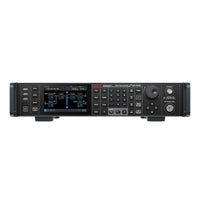
| Frequency Range | Freq. Resolution | Level Range | Phase Noise | Mech. Atten. | Display | |
|---|---|---|---|---|---|---|
|
CW: 9 kHz – 22 GHz IQ: 5 MHz – 6 GHz |
0.001 Hz | -135 dBm – +25 dBm | <-122 dBc/Hz (1 GHz@20 kHz) | Optional | 5" Touch |
| USG5000V Digital RF Generators | ||||||
|
9 kHz – 22 GHz | 0.001 Hz | -135 dBm – +25 dBm | <-122 dBc/Hz (1 GHz@20 kHz) | Optional | 5" Touch |
| USG5000M Analog RF Generators | ||||||
|
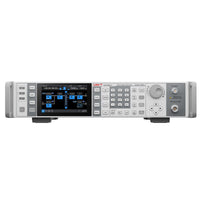
CW: 9 kHz – 6.5 GHz IQ: 5 MHz – 6 GHz |
0.001 Hz | -135 dBm – +25 dBm | <-122 dBc/Hz (1 GHz@20 kHz) | Optional | 5" Touch |
| USG3000V Digital RF Generators | ||||||
|
9 kHz – 6.5 GHz | 0.001 Hz | -135 dBm – +25 dBm | <-122 dBc/Hz (1 GHz@20 kHz) | Optional | 5" Touch |
| USG3000M Analog RF Generators | ||||||
Accessories & Options

Buying Guide
UNI-T RF Signal Generators — Buyer's Guide
About This Collection
UNI-T's RF signal generator catalog covers 14 models across two frequency platforms (USG3000 mid-band, USG5000 high-band), in two modulation configurations (Analog M-series, Vector V-series), with optional mechanical attenuator (-P) for high-cycle automated test. Frequency coverage spans 9 kHz to 22 GHz; output power range typically −127 to +20 dBm.
If you need baseband or sub-100-MHz arbitrary-waveform stimulus instead, see the Waveform Signal Generators. The parent Generators guide covers the waveform-vs-RF decision.
What Every UNI-T RF Generator Shares
Decision 1: Analog (M) or Vector (V)?
M-Series — Analog Modulation
V-Series — Vector + Analog
If unsure: Buy Analog unless you have a specific I/Q-modulation workload on your bench today. Vector capability adds significant cost and isn't needed for receiver test, EMC, or traditional comms work. The upgrade path is to buy a new instrument if your needs change — vector cannot be added to an analog chassis after the fact.
Decision 2: Pick Your Frequency Ceiling
Rule of thumb: scope the generator to at least 2× the highest signal of interest, or to the highest harmonic you need to inject. Cellular / Wi-Fi sub-6 work fits inside USG3000; microwave, radar, satellite, and 5G FR2 lower-band work needs USG5000.
| Platform | Frequency | Best for |
|---|---|---|
| USG3045 (4.5 GHz) | 9 kHz – 4.5 GHz | Sub-6 cellular, Wi-Fi 5/6 (2.4 / 5 GHz), Bluetooth, IoT/LoRa, IF stages, classic comms, EMC pre-compliance |
| USG3065 (6.5 GHz) | 9 kHz – 6.5 GHz | Above + Wi-Fi 6E (6 GHz band), full sub-6 5G NR (n77/n78/n79), C-band uplink |
| USG5014 (14 GHz) | 9 kHz – 14 GHz | X-band radar, microwave subsystem test, satellite Ku-band downlink, broadcast distribution, ECM |
| USG5022 (22 GHz) | 9 kHz – 22 GHz | K-band radar, satellite Ku/K uplink, 5G FR2 (24/26/28/40 GHz reachable via mixer), automotive radar IF |
Decision 3: Standard or -P Mechanical Attenuator?
Every USG model is available as a standard configuration (electronic step attenuator only) or as a -P variant (mechanical attenuator added in addition to the electronic step). Both deliver the same frequency range and modulation set; the difference is attenuator longevity under high-cycle operation.
Standard (no -P suffix)
-P Mechanical Attenuator
The USG5022 (22 GHz) ships only in -P configuration. All other platforms (USG3045, USG3065, USG5014) offer both standard and -P.
Complete Model Matrix
| Model | Frequency | Type | Attenuator |
|---|---|---|---|
| USG3045M | 9 kHz – 4.5 GHz | Analog | Electronic |
| USG3045M-P | 9 kHz – 4.5 GHz | Analog | + Mechanical |
| USG3045V | 9 kHz – 4.5 GHz | Vector | Electronic |
| USG3045V-P | 9 kHz – 4.5 GHz | Vector | + Mechanical |
| USG3065M | 9 kHz – 6.5 GHz | Analog | Electronic |
| USG3065M-P | 9 kHz – 6.5 GHz | Analog | + Mechanical |
| USG3065V | 9 kHz – 6.5 GHz | Vector | Electronic |
| USG3065V-P | 9 kHz – 6.5 GHz | Vector | + Mechanical |
| USG5014M | 9 kHz – 14 GHz | Analog | Electronic |
| USG5014M-P | 9 kHz – 14 GHz | Analog | + Mechanical |
| USG5014V | 9 kHz – 14 GHz | Vector | Electronic |
| USG5014V-P | 9 kHz – 14 GHz | Vector | + Mechanical |
| USG5022M-P | 9 kHz – 22 GHz | Analog | Mechanical |
| USG5022V-P | 9 kHz – 22 GHz | Vector | Mechanical |
Recommended Configurations
Sub-6 5G / Wi-Fi 6 Receiver Test
Choose: USG3065V
6.5 GHz ceiling covers Wi-Fi 6E and full sub-6 5G NR (n77/n78/n79). Vector I/Q baseband for QAM, OFDM, and standards-based digital signals. Add -P only if the bench runs unattended high-cycle automated test.
EMC Pre-Compliance Bench
Choose: USG3045M
4.5 GHz analog covers conducted and radiated emission injection bands. AM/FM/Pulse modulation is sufficient for CISPR and FCC pre-compliance setups. The lower-cost analog M-series saves budget for the rest of the EMC chamber.
X-Band Radar & Microwave Subsystem Test
Choose: USG5014M-P
14 GHz covers X-band radar (8–12 GHz) and Ku-band lower edge. -P mechanical attenuator handles high-cycle automated characterization sweeps. Vector capability rarely needed for pulse radar work.
Satellite / 5G FR2 Lab
Choose: USG5022V-P
22 GHz reaches K-band satellite uplink and the FR2 24/26/28 GHz bands via external mixer or harmonic generation. Vector I/Q for 5G NR FR2 modulation formats. -P attenuator standard at this frequency tier.
Why Choose UNI-T RF Generators?
Frequency floor matters
Every UNI-T RF generator starts at 9 kHz — below where many competitor RF sources begin. That covers VLF, HF, and the IF stages that downstream measurement chains depend on, in one instrument.
Vector capability without enterprise pricing
UNI-T's V-series brings I/Q baseband modulation into the price tier where most labs buy analog-only instruments elsewhere. If wireless digital comms work appears on your bench, you don't need a second chassis.
OCXO reference standard
Internal 10 MHz OCXO ships standard on every model. External 10 MHz in/out for system lock against a house reference. No paid option to enable frequency stability.
5-year warranty
Three years standard plus two free with registration. Longer than the 2-year and 3-year warranties typical at this price tier for RF instruments.
FAQ
Do I really need Vector if I'm only doing receiver test?
For traditional receiver test against analog modulation (FM broadcast, two-way radio, analog comms, EMC pre-compliance), the M-series is sufficient and gives you the cleanest path. Buy Vector only when you have specific I/Q digital modulation work on the bench — QAM constellations for QPSK/8PSK/16QAM/64QAM, OFDM for Wi-Fi or LTE, custom arbitrary I/Q for proprietary digital schemes. If you're not sure today whether digital comms work is coming, buy Analog and trade up if it does.
Can I add Vector capability to an M-series later?
No. Vector requires internal I/Q baseband hardware that the M-series doesn't have. If you're on the fence and you can afford the upgrade now, buy V-series for future-proofing. If budget is the deciding factor, buy M-series and trade in if needs change.
What's actually different about the -P (mechanical attenuator) variant?
Same RF performance, same frequency range, same modulation. The -P adds a mechanical step attenuator in parallel with the electronic step attenuator. On a benchtop where the operator changes power level a few times per measurement, the electronic attenuator is rated for the full instrument lifetime. On an automated test rack that steps power level thousands of times per day across years of operation, the mechanical attenuator handles the high-cycle work and extends serviceable life. Choose -P only if your use case is the second one.
What output power can I expect?
Typical range is −127 dBm to +20 dBm with the electronic step attenuator engaged. Specific power level at each frequency depends on the model — check the individual product page for guaranteed and typical levels in each frequency band. Output is calibrated into 50 Ω load through an N-type connector on every USG model.
Can I reach 5G FR2 (24–40 GHz) frequencies?
Direct output: the USG5022 (22 GHz) reaches the lower edge of FR2 around n257 (26.5–29.5 GHz lower limit). For full FR2 coverage including n258/n261, use an external mixer or harmonic generator driven by the USG5022 as a clean source — this is the standard approach for sub-mmWave receiver test at this price tier. For native FR2 coverage including upper-band 38–40 GHz, contact us about higher-frequency platforms.
What's in the 5-year warranty?
Parts, labor, and return shipping for 3 years standard plus 2 additional years when you register the instrument within 90 days of purchase. Calibration is a separate service.

